



The starting point
Urban Goes Green started in Sampaloc, Manila in 2021 to make soil, pots and plants easy to find for people who want to start gardening in the city. It grew to garden centers across Metro Manila, but the website had not kept up. In May 2026 it still had roughly seven pages on a traditional CMS.
That meant almost nothing for Google to rank. People searching for garden soil, plant care or a supplier near them found other sites, and every small change to the website was an afternoon of admin work.
What I did
No single tactic did this. The result came from six pieces moving together.
- A rebuilt, automated website. Fast, crawlable and structured so every new page inherits the right layout, links and schema. Publishing became a build step instead of manual work.
- Content at scale. 448 plant guides, more than 300 gardening articles, branch pages and a soil calculator, each answering a question customers actually asked.
- Technical SEO. Page speed, indexing, internal links, structured data and clean canonicals, with no crawl traps.
- Google Business Profile. Every location complete and consistent with the website, so local searches turn into calls and directions.
- Entity SEO. Consistent naming, schema and off-site signals connecting the brand, the people and the locations.
- Reviews. The human proof that decides it once a customer has found the business.
Result 1: Google Search Console
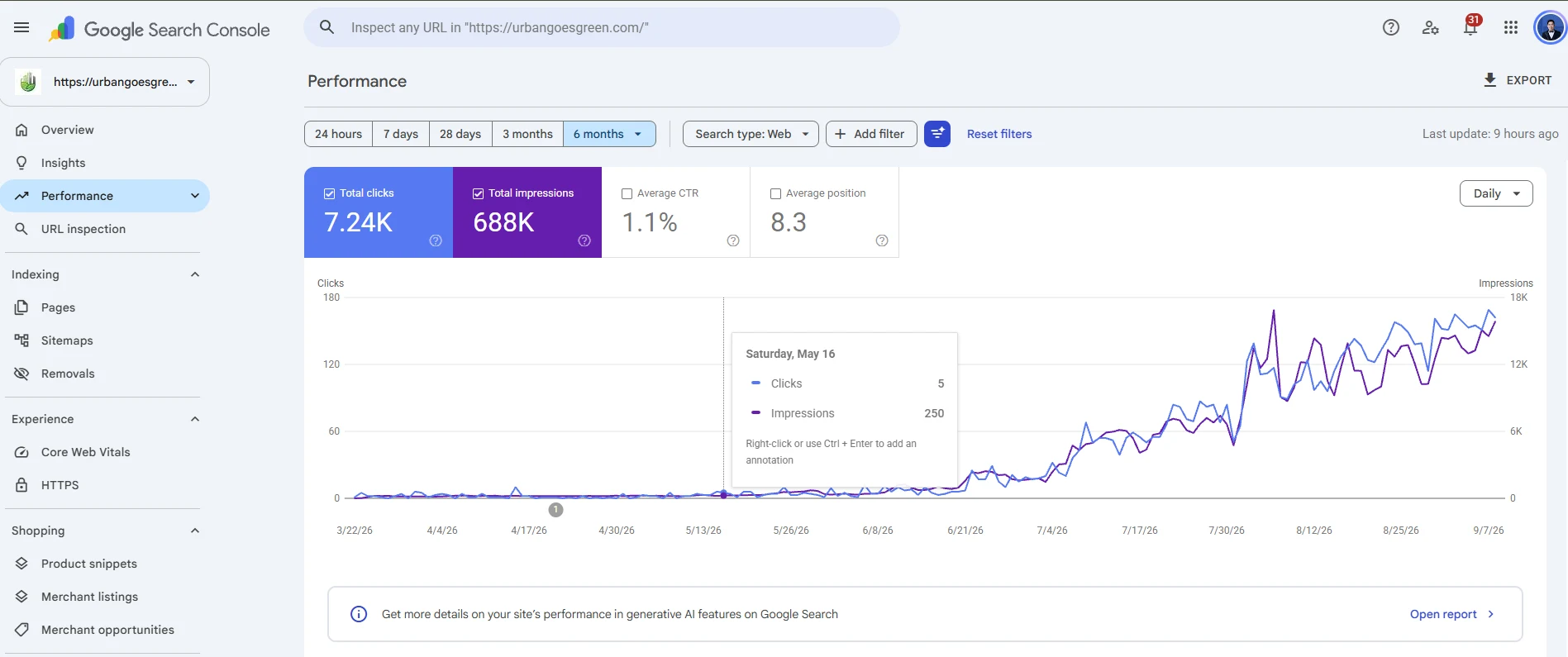
Clicks, latest 3 months against the 3 months before: 230 to 7.36K. Impressions grew too, but clicks are the number that brings people to the branches, so that is the one I report first.
Result 2: Google Analytics
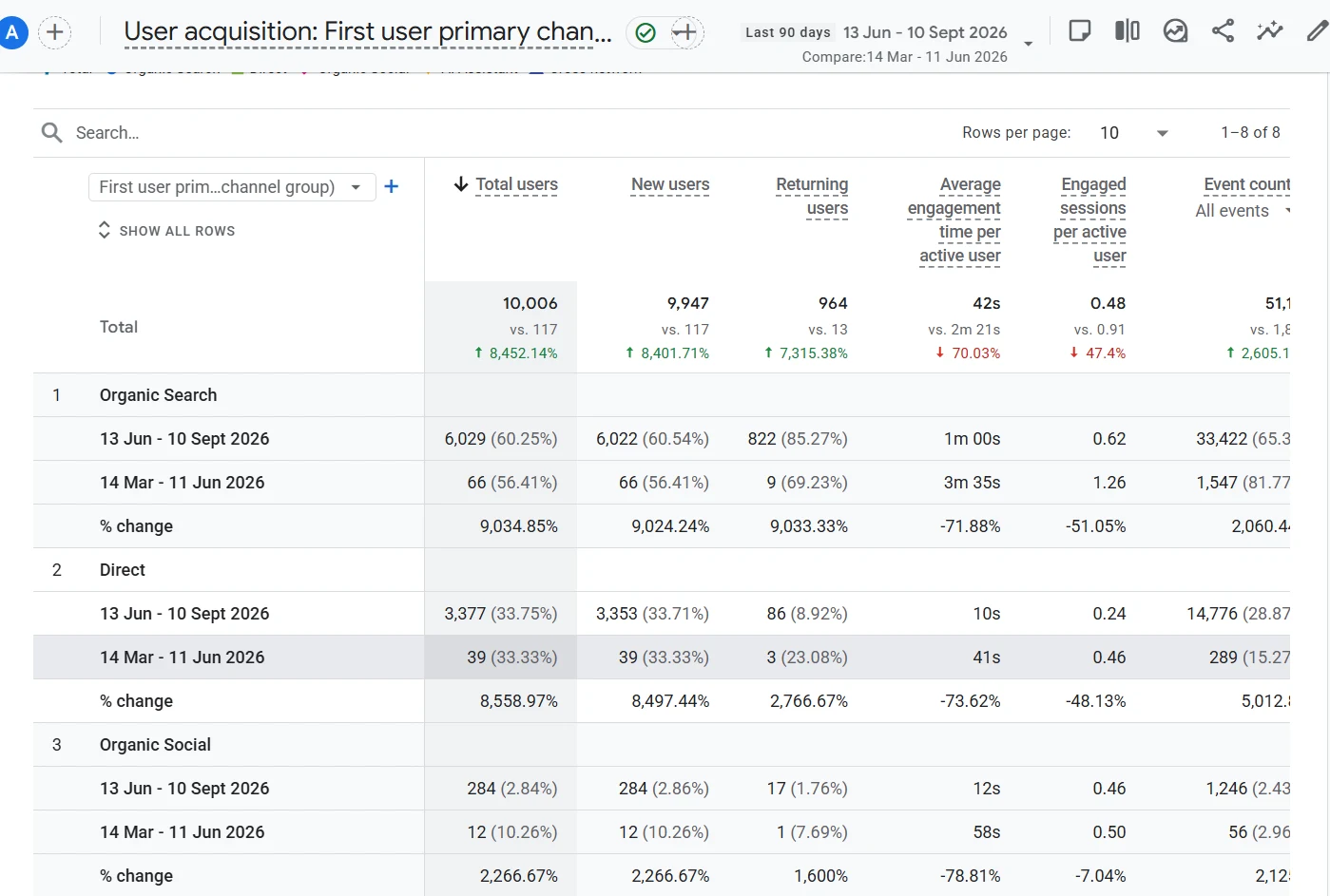
| Channel | 14 Mar to 11 Jun 2026 | 13 Jun to 10 Sep 2026 |
|---|---|---|
| Total users | 117 | 10,006 |
| Organic search | 66 | 6,029 |
| Direct | 39 | 3,377 |
| Organic social | 12 | 284 |
One honest note: average engagement time per user fell from 2 minutes 21 seconds to 42 seconds. That is expected when a site moves from a handful of visitors who already know the business to thousands of new readers landing on a single guide for a quick answer. The number I watch is whether those readers come back and contact a branch, which the next result shows.
Result 3: Google Business Profile
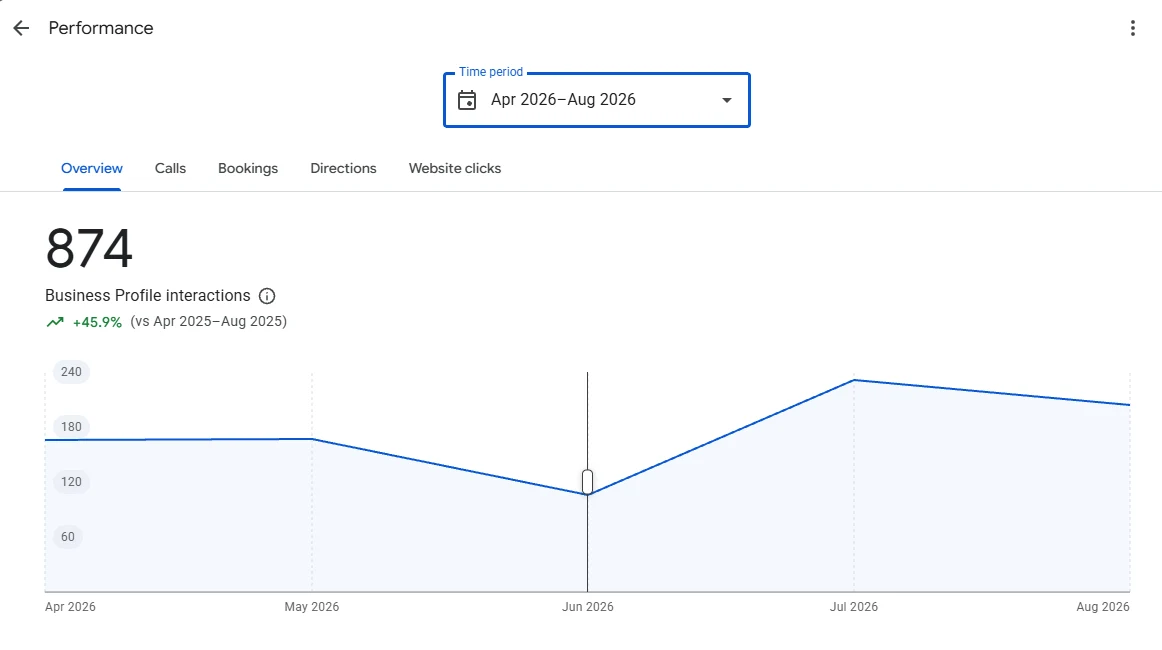
| Action | Apr to Aug 2025 | Apr to Aug 2026 |
|---|---|---|
| Calls | 94 | 190 (+102%) |
| Website clicks | 74 | 150 (+103%) |
| Direction requests | 431 | 534 (+24%) |
| Total interactions | 599 | 874 (+46%) |
Calls and website clicks doubled. Direction requests grew more slowly, which makes sense: people could already find the branches, they just had more reasons to call first.
Result 4: 18 months of Business Profile history in one place
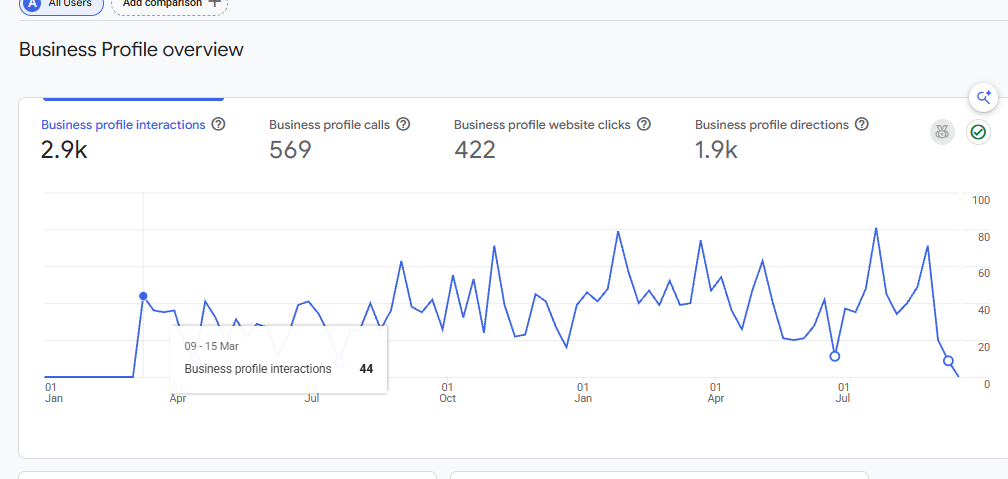
Linking the two accounts put local actions next to website traffic, so seasonal peaks and the effect of changes are visible in one report. See the step-by-step guide.
Does an automated website load slower on mobile?
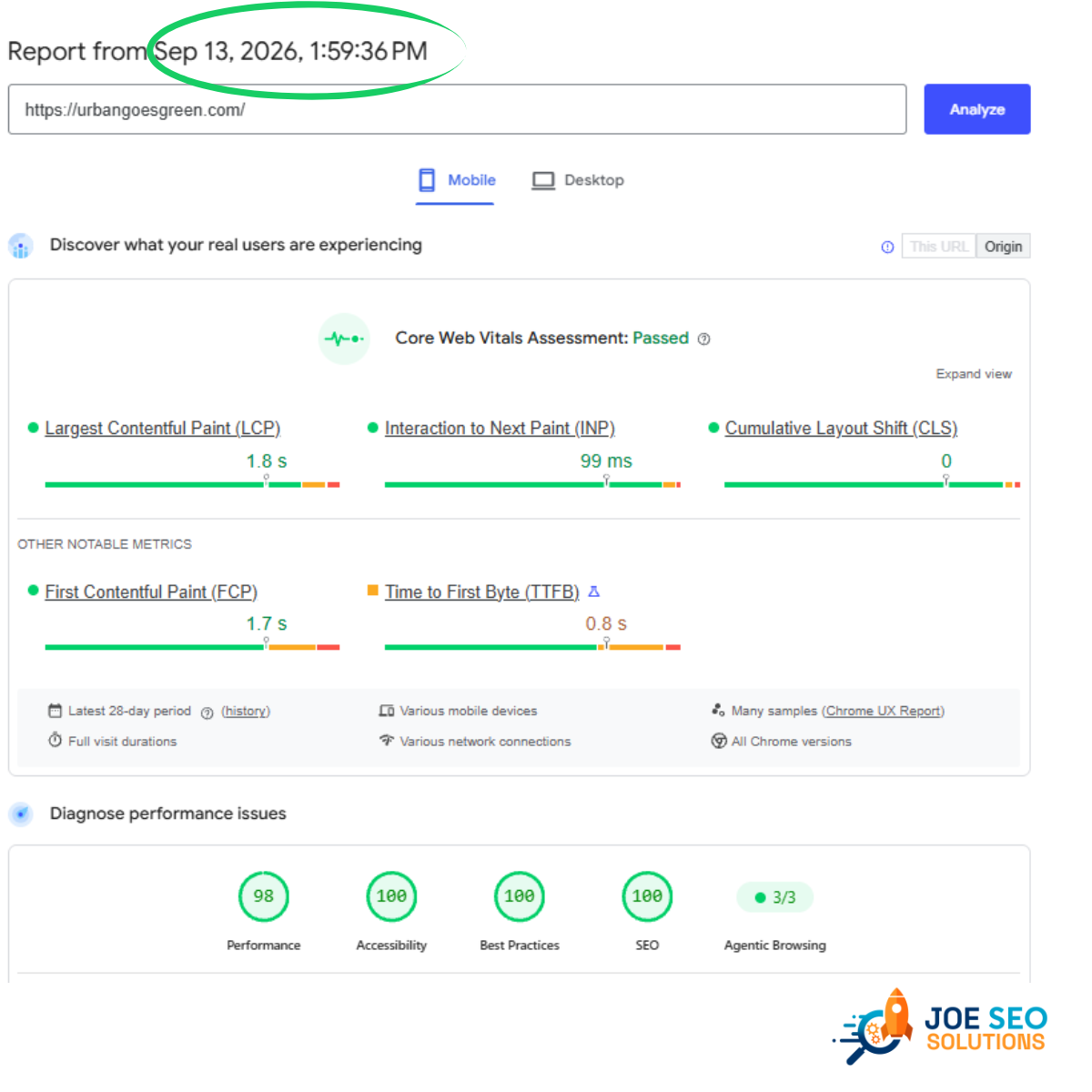
It is a fair question. A site with 927 pages built by a publishing system sounds heavy. In practice it is the opposite: every page comes from the same templates, so a speed fix is made once and published to every page at the same time, instead of being patched page by page.
Disclaimer
These scores were not in place during the growth period covered by this case study. On the morning of 13 September 2026 the same mobile test showed Performance 69. The traffic and Business Profile results above were earned before the speed work. What the screenshot shows is how fast an automated site can be brought to this level: from 69 to 98 in 53 minutes.
That turnaround is only possible because the website is automated. See every step and screenshot in How I Took Mobile Page Speed From 69 to 98 in 53 Minutes.
What it cost
No agency retainer and no developer invoices. These were the only direct costs, from my own records:
| Item | Cost | Period |
|---|---|---|
| Domain and hosting | ₱6,000+ | Per year |
| AI tools | USD 360 (USD 120 a month) | 3 months |
| Total direct cost | ₱6,000+ a year, plus USD 360 in tools | First 3 months |
That budget covered 920 new pages, the technical SEO work and the Google Business Profile updates. My own working time is not included.
New projects cost less to run. Building Urban Goes Green is where the publishing pipeline was created. Now that it is in place, new sites plug straight into it, which cuts the AI tool cost by 67%, to about USD 120 for the same three months instead of USD 360.
The tools are the cheap part. What clients pay for is the system, the content and the SEO work that turns pages into rankings, calls and revenue.
Timeline
- 2021
Urban Goes Green starts in Sampaloc, Manila.
- Mid-May 2026
Website rebuilt with automated publishing. About seven pages before the move.
- June to August 2026
Content engine runs: plant guides, articles, branch pages and the soil calculator.
- September 2026
927 pages live. Clicks reach 7.36K in the latest 3 months, up from 230 in the 3 months before. Business Profile linked to Google Analytics.
What this means for your business
- A 7-page website has nothing to rank. Visibility followed the pages, and the pages followed the publishing system.
- Speed of publishing is a ranking factor you control. Adding hundreds of useful pages in months is only practical when publishing is automated.
- Local actions follow search visibility. The Business Profile gained calls and website clicks as the website grew.
Want the same system?
SEO-Ready Websites: live in under a week, up to 100 pages in 3 months
The approach behind this case study, run end to end for your business. You choose the domain, we build, publish and optimise.
See SEO-Ready Websites